menu
menu


Sunset T'ai Chi on the Lawn - Fall 2022
SUBSCRIBE TO OUR NEWSLETTER HERE.
We are currently not accepting requests for space reservations and events as our team prepares for the public opening of the Commons next year. Learn more.
Follow Us


Title
Sunset T'ai Chi on the Lawn - Fall 2022
When
Thu. Sep 1, 2022 - Thu. Nov 3, 2022 (10 weeks)
Every Thursday from 6:00 PM to 7:00 PM
Where
The Lawn — In Front of the Rotunda
Beginning 10/13 class will be held from 6:00-7:00pm to capture more daylight.
RAIN LOCATION
In case of rain, use this Zoom link
https://us02web.zoom.us/j/85878754646?pwd=Ym1vVURxamh4L3lFS1kwcWhZVTR1Zz09
Meeting ID: 858 7875 4646
Passcode: 986559
This class is free and open to the public. All levels of experience are welcome!
Instructor: Hiromi Johnson
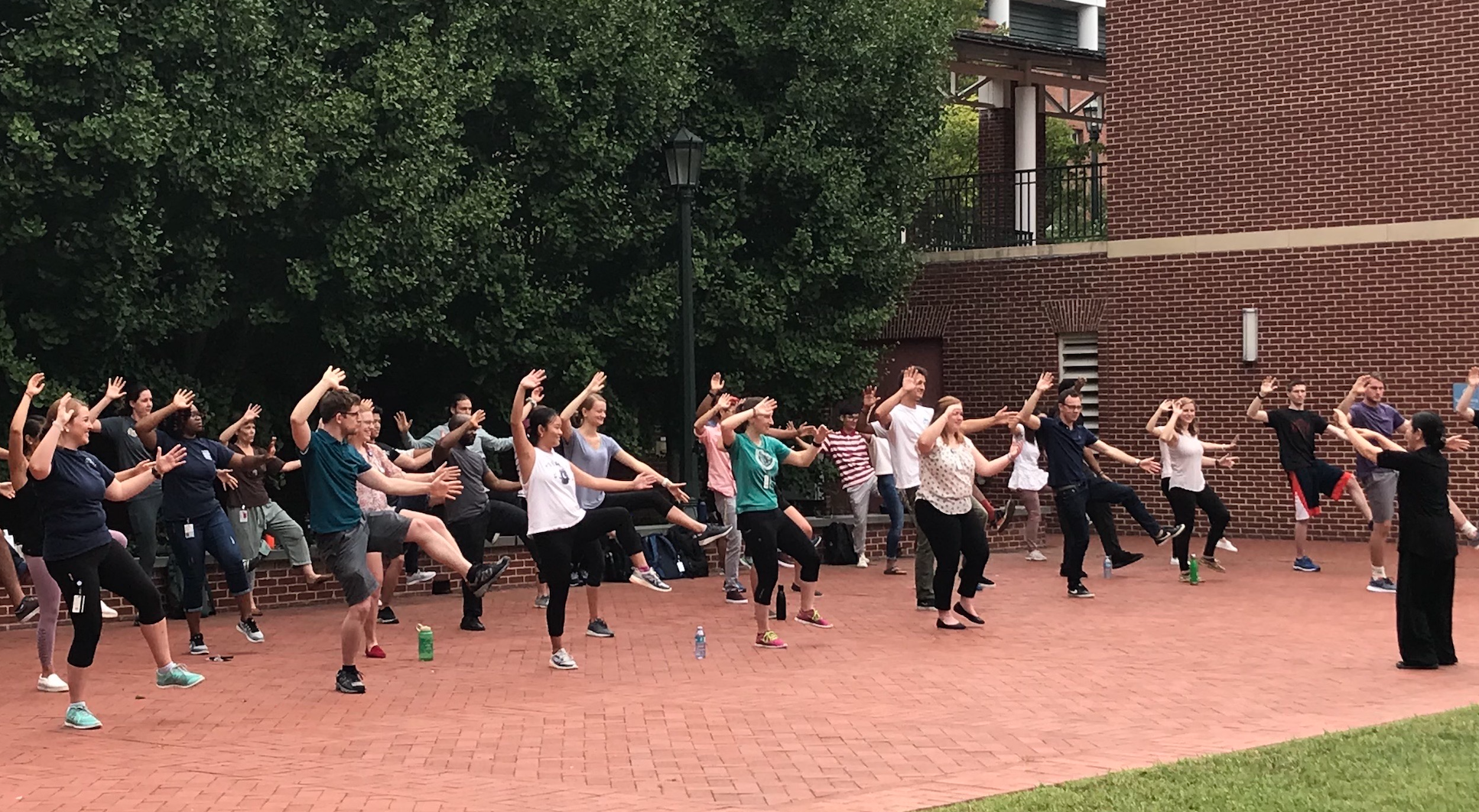
This class, co-sponsored with Compassionate Care Initiative, will cover the basics of T'ai Chi, a martial art form developed in China centuries ago for self defense. Aside from the many physical benefits of T'ai Chi, the slow, continuous, and flowing movements of the practice lower stress; promote resilience; and enhance focus and concentration. Performed quietly in unison with a group, T’ai Chi also can increase harmony among particpants.
Learn more about the benefits of practicing T’ai Chi
While the movements improve physical health, the meditative aspects of T’ai Chi also improve emotional well-being and decrease the effects of depression and anxiety. Additionally, learning a new skill improves neural pathways, fundamentally rewiring the brain.
Research
A 2008 American College Health Survey at Arizona State University (ASU) found that the most frequent factors negatively impacting academic performance within the last 12 months were stress (20.3%), sleep difficulties (16.5%), and anxiety (14.6%). A meta-analysis found T’ai Chi to have a moderate effect on symptoms of anxiety (Hedges’ g = 0.66, in Wang et al., 2010.) T’ai Chi classes at ASU demonstrated that increased mindfulness was associated with improved sleep, self-regulatory self-efficacy, mood, and perception of stress (Caldwell et al., 2010, 2011). There were increases in the capacity for mindfulness and improved sleep across the semester for T’ai Chi students while no change was detected in the control group (Caldwell 2011).
Find more contemplative practice offerings here.